Rodriguezia venusta: Notes from Growing a Miniature Epiphyte
Christian St-PierreRodriguezia venusta: miniature orchid, gentle elegance
Rodriguezia venusta is one of those orchids that almost feels unreal at first glance, small pseudobulbs, a compact habit, and then, unexpectedly, a graceful arching spike carrying bright, clean flowers. It’s not a “large” orchid by any means, yet it has a refined presence that immediately reads as classic epiphytic elegance.
What I appreciate most about this species is the way it behaves. It is a true miniature epiphyte, and it responds best when treated as such: no oversized containers, no heavy media, no forcing. In my collection, it clearly rewards consistency over intensity, stable humidity, gentle air movement, and roots that are always allowed to breathe.


As for fragrance, it is often mentioned in descriptions, but in my experience it remains discreet. If present, it’s subtle and only noticeable up close, and not always. I grow Rodriguezia venusta primarily for its form, its balance, and the quiet elegance of its bloom rather than for scent.
Origin and history
Rodriguezia venusta originates from humid tropical forests of northern South America, where it grows as an epiphyte attached to tree branches, often in areas with frequent rainfall, high ambient humidity, and constant air movement. These forests are typically bright but shaded, with light filtered through the canopy rather than direct sun.
In its natural habitat, the plant experiences regular moisture without stagnation. Rain, mist, and rapid drying cycles shape its root system, which is fine, active, and highly dependent on airflow. Temperatures tend to be warm to intermediate, with little seasonal variation, but nights are usually slightly cooler than days.

Understanding this environment explains much of its behavior in cultivation. Rodriguezia venusta is not adapted to dryness, heavy substrates, or confined root systems. It expects humidity, movement, and stability rather than extremes.
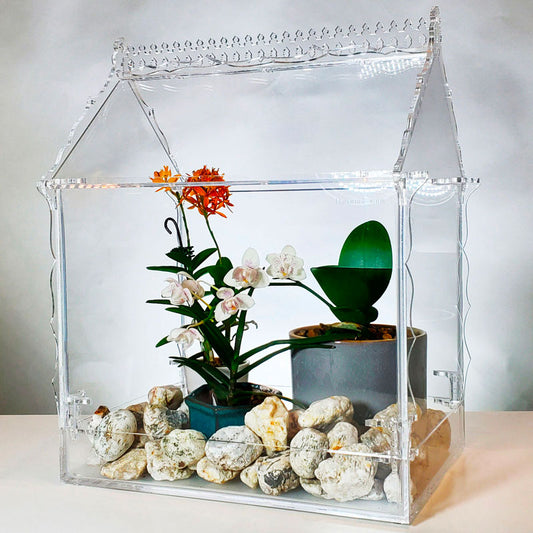
This is also why, once the plant is in bloom, I sometimes move it from the greenhouse into one of my terrariums. Not to change its care, but to preserve the same conditions, steady humidity, gentle airflow, and stable light, while allowing me to better observe and enjoy the flowers up close. For this orchid, continuity matters more than location.
How to grow Rodriguezia venusta: Care guide
Summary
- Scientific name & family: Rodriguezia venusta (often listed; Kew: synonym of R. bracteata): Orchidaceae
- Plant type: Miniature epiphyte
- Light: Medium light / bright shade
- Temperature: Intermediate to warm-intermediate (avoid extremes)
- Watering: Regular moisture; don’t let it stay bone-dry for long, especially mounted
- Humidity: Higher humidity + constant air movement
- Mounting / potting: Excellent mounted (your case); small pot possible but keep it airy
- Fertilization: Light, consistent feeding during growth; flush to avoid salt buildup
- Blooming: Often spring/summer depending on conditions; flowers often described as fragrant
Light
Bright shade is the sweet spot, enough light to support flowering, without heat or harsh direct sun.

Temperature
Rodriguezia venusta is generally considered a warm-to-intermediate growing epiphyte. In its native tropical range, conditions are neither extreme nor highly variable, and this is reflected in how the plant responds in cultivation.
From care observations and climate data:
- Daytime temperatures: about 24–29 °C (75–85 °F) during active growth.
- Nighttime temperatures: ideally around 18–22 °C (64–72 °F) to provide a comfortable drop that mimics natural forest conditions.
This moderate contrast between day and night echoes the gentle fluctuations found in its natural habitat and tends to support stronger, steadier growth and reliable flowering. Avoid exposing the plant to prolonged heat above 30 °C (86 °F) or cool nights below about 15 °C (59 °F), as these extremes typically cause stress rather than benefit.
In my own collection, maintaining this warm-intermediate range in the greenhouse, with slightly cooler nights, has helped the plant grow more evenly and bloom without undue hesitation.
Watering
Mounted orchids are a different game: roots dry fast. The goal is frequent moisture + fast drying + airflow. If it stays dry too long, it sulks; if it stays wet with stagnant air, it rots.
Humidity + air movement
This is the pairing that makes or breaks mini epiphytes: you can run higher humidity, but only if the air is always moving.
Substrate / mounting
You told me yours is mounted on bark, which fits this species well. Mounted culture is often recommended for Rodriguezia types, but it does demand a reliable watering/humidity routine.

Fertilization
There are countless fertilization approaches for orchids, this is simply my own routine, and so far it works well in my conditions.
I feed lightly but regularly during active growth, never at full strength, and I flush periodically to prevent salt buildup (especially important for fine-rooted mini epiphytes on mounts).
My fertilization routine includes:
- Balanced orchid fertilizer (MSU formula)
- Water pH control (I aim for 5.5–6.5)
- Silicon (small amounts)
- Fresh seaweed extract (occasional, not constant)
- Superthrive (very diluted, used sparingly, mainly for stress/recovery)
I don’t try to push growth. With this kind of miniature epiphyte, steady nutrition supports flowering far better than aggressive feeding.
In my experience, reblooming Rodriguezia venusta is less about triggering something specific and more about not disturbing the plant. When conditions remain stable, flowering tends to return on its own rhythm.
What has worked best for me:
-
Maintain bright shade
I don’t increase light to force blooming. Pushing light too far tends to dry the plant faster and adds unnecessary stress. -
Keep moisture regular
This orchid does not tolerate long, crispy-dry periods, especially when mounted. Even brief droughts can slow or interrupt the flowering cycle. -
Maintain high humidity with constant airflow
Humidity alone is not enough. Air movement is what keeps the roots active and healthy over time. -
Feed lightly during active growth
I fertilize at low concentration and flush regularly. Fertilizer supports overall health, but it does not replace good environmental stability.
When the plant is comfortable, spikes tend to appear naturally, without any need for intervention.
After flowering
After blooming, I avoid making sudden changes. I don’t cut the inflorescence immediately unless it is clearly drying, and I return the plant to its normal growing rhythm. If the orchid has been moved indoors for viewing, it goes back to the greenhouse once flowering is finished, keeping conditions as consistent as possible.
The goal after flowering is simply to let the plant recover without stress.
Common mistakes
The most common problems I’ve seen or experienced come from:
- Letting the plant stay dry for too long
- Pushing light or heat in an attempt to “encourage” blooming
- High humidity without sufficient air movement
- Frequent changes in location or care routine
With Rodriguezia venusta, restraint and consistency are far more effective than force.
Varieties and similar plants
True “varieties” aren’t the main story here; instead, if you like the look and habit, you’ll probably also enjoy:
- Other Rodriguezia species (similar arching sprays)
- Comparettia / Rodriguezia-type mini epiphytes that like humidity + airflow
- Small Oncidium-alliance epiphytes with fine roots and mounted culture tendencies

FAQ about Rodriguezia venusta
Is Rodriguezia venusta difficult to grow?
Not particularly. It’s a cooperative orchid as long as its basic needs are respected. That said, when grown mounted, it is unforgiving of neglect. Consistency in watering and humidity matters far more than complexity.
Does Rodriguezia venusta need a terrarium or orchidarium?
No, it’s not mandatory. The plant can grow perfectly well outside a terrarium as long as humidity and airflow are adequate.
That said, in very dry indoor environments, a terrarium or enclosed growing space can help maintain stable humidity while still allowing good air movement. For me, it’s simply a practical way to preserve conditions rather than a requirement.
Mounted or potted: which is better?
Mounted culture suits this species very well and reflects how it grows in nature, but it requires more frequent watering. A small pot can also work if the mix is very airy and never compacted. The key is fast drying paired with regular moisture.
Is Rodriguezia venusta fragrant?
Fragrance is often mentioned in descriptions, sometimes described as sweet. In my experience, it is subtle and not always noticeable. When present, it’s something you discover up close rather than a scent that fills the room.
Why do some plants decline in cultivation?
Most problems come from either prolonged dryness (especially for mounted plants) or stagnant moisture without airflow. This orchid tolerates neither extreme well.
Is this a good orchid for beginners?
It can be, provided the grower already manages humidity and watering with some regularity. It’s not difficult, but it does reward attention and consistency more than casual care.

I’m Christian
I’ve been growing orchids for many years, with a particular interest in species orchids and small epiphytes that reward patience and observation rather than intervention. Over time, I’ve learned that orchids respond best to stability, not force.
In my collection, I work with two complementary environments: a warmer growing space for orchids that enjoy consistent heat, and a cooler, more temperate space better suited to cloud-forest species and delicate epiphytes. This separation allows me to respect each plant’s natural rhythm instead of trying to make everything fit into a single setup.
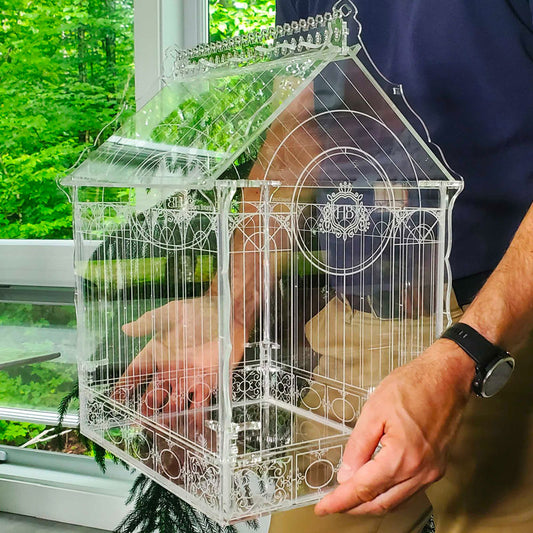
I share here what I observe firsthand, what works, what doesn’t, and what only reveals itself after time. Alongside my growing spaces, I also build Wardian-case-inspired mini greenhouses, not as display objects, but as practical tools to maintain humidity, airflow, and consistency for orchids that benefit from a more controlled environment.
Everything I write comes from practice, not theory, and from the quiet satisfaction of letting orchids grow at their own pace.
References
-
Rodriguezia venusta: Plants of the World Online (Kew Science)
Taxonomic details showing Rodriguezia venusta as a listed name (synonym of Rodriguezia bracteata).
-
Rodriguezia venusta: OrchidSpecies (IOSPE)
Description of the species, habitat, morphology, and floral characteristics, including fragrance and distribution.
-
Rodriguezia venusta: OrchidRoots
Synonymy and taxonomic usage, useful for understanding naming and cultivation references.

Conclusion
Rodriguezia venusta is not an orchid that asks to be managed or optimized. It asks to be understood and respected. In my experience, when its basic needs are met, regular moisture, good airflow, stable humidity, and gentle light, it grows and flowers without complication.
What I appreciate most about this species is its balance. It remains discreet in growth, never invasive, yet becomes striking the moment it blooms. It doesn’t dominate the space, but it rewards attention with a refined, elegant display that feels perfectly proportioned to the plant itself.
Grown patiently, without forcing, Rodriguezia venusta becomes a quiet companion in the collection, one that reminds me why miniature epiphytic orchids are so satisfying to grow. They don’t rush, they don’t demand, and when they bloom, they do so on their own terms.